 Sable & Sparrow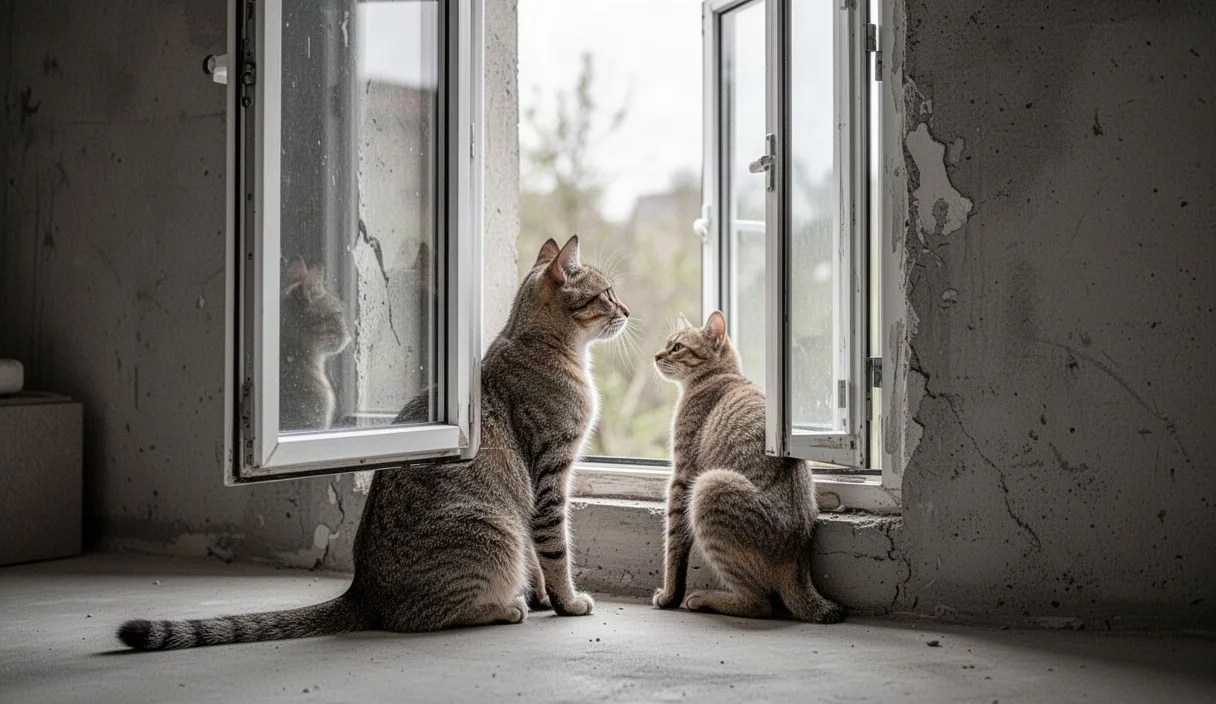
The indoor versus outdoor question sits at the center of most cat-care decisions. It touches safety, health, boredom, and daily routine. There is no single right answer for every cat or every home.
This comparison lays out the practical differences. It does not tell you what to choose. It gives you the facts to choose well.
What "indoor" and "outdoor" actually mean
The terms get used loosely. It helps to define them first.
An indoor cat stays inside the home at all times. Some indoor cats get supervised time in a yard, on a leash, or in a carrier on a balcony. This still counts as indoor, because the exposure is controlled.
An outdoor cat has free access to the outside world. This can mean a few hours a day. It can mean all day with a return at night. It can mean no fixed schedule at all.
There is a third category that confuses people: the "indoor-outdoor" cat. This cat lives mostly inside but goes out unsupervised for short periods, often through a cat flap. In practice, this cat faces most of the same risks as a fully outdoor cat, just for less time.
Safety differences
Outdoor cats face more physical risk. This is not a matter of opinion, it is a matter of exposure.
Cars are the most common cause of sudden death in outdoor cats under five years old, according to veterinary trauma studies. A cat does not need to live near a busy road for this risk to apply. Quiet streets still carry traffic, and cats misjudge speed.
Other physical risks outdoors include:
- Fights with other cats, which can cause deep puncture wounds that abscess days later
- Dog attacks, especially in areas with unleashed dogs
- Poisoning from antifreeze, rodent bait, or garden chemicals
- Getting trapped in sheds, garages, or under vehicles
- Falls from fences or trees
Indoor cats are not. They can be injured by falls from windows, a pattern common enough in cities that veterinarians have a name for it: high-rise syndrome. They can ingest houseplants, string, or medication left within reach. The risks are fewer, but they are not zero.
Health and disease exposure
Outdoor cats encounter more pathogens simply by moving through more environments and more animals.
Feline leukemia virus and feline immunodeficiency virus spread mainly through bite wounds from other cats. An outdoor cat that fights or mates is at higher risk. Indoor-only cats with no contact with outdoor cats have close to no exposure risk for these two viruses.
digestive balance follow a similar pattern. Fleas, ticks, and intestinal worms are picked up from soil, prey, and other animals. Outdoor cats need more consistent digestive balance prevention. A veterinarian can recommend a schedule based on the region and the cat's habits, since risk varies by climate and local wildlife.
Indoor cats tend to live longer on average, according to multiple veterinary association estimates, often cited in the range of 10 to 15 years for indoor cats versus shorter average lifespans for cats with regular outdoor access. These are population averages, not guarantees for any individual cat.
| Factor | Indoor cats | Outdoor cats |
|---|---|---|
| Traffic exposure | None | Present in most areas |
| Fight-related injury risk | Low | Moderate to high |
| digestive balance exposure | Lower | Higher, needs regular prevention |
| FeLV/FIV risk | Very low if no outdoor contact | Elevated with unneutered or fighting cats |
| Natural movement and hunting | Limited, needs to be built in | Available by default |
Enrichment needs indoors
An indoor cat does not get the outdoor world by accident. The household has to provide it.
Vertical space matters. Cats rest higher than they walk. A shelf, a cat tree, or a windowsill perch gives an indoor cat somewhere to observe the room from above, which many cats seek out on their own once it is available.
Hunting behavior needs an outlet even without live prey. Rotating three or four toys weekly keeps novelty in the mix. A wand toy used for five to ten minutes, once or twice a day, lets a cat stalk, chase, and catch something, which a bowl of food alone does not offer.
Food puzzles slow down eating and add mental work. A simple version can be made by cutting holes in a cardboard box and hiding kibble inside. Commercial puzzle feeders do the same thing with more durability.
Scratching surfaces need variety in material and angle. A vertical sisal post suits one cat, a flat cardboard scratcher suits another. Offering both avoids guesswork.
Enrichment cats get outdoors
Outdoor access removes the need to engineer stimulation, because the environment does the work.
Climbing happens on fences and trees without a cat tree being involved. Hunting happens on insects, rodents, and birds, which some owners see as a benefit and others see as a problem, particularly where local wildlife populations are a concern.
Scent marking and territory patrol give an outdoor cat a daily "job" that indoor cats often lack. Weather changes, new smells, and other animals passing through add variation that a single household cannot fully replicate.
The tradeoff is control. An indoor owner decides what enrichment looks like and can adjust it. An outdoor cat's enrichment is unsupervised, and the same variety that stimulates the cat also carries the risks described above.
Middle-ground options like enclosed patios
Many owners land between the two extremes. An enclosed outdoor space, sometimes called a catio, is one common compromise.
A catio is a fully screened or fenced structure attached to a window, door, or balcony. The cat gets fresh air, sunlight, and a view, without traffic or contact with unknown animals. Sizes range from a small window box a few feet deep to a walk-in enclosure spanning most of a yard.
Leash walking is another middle option. It requires a harness the cat cannot back out of and a slow introduction, often over one to two weeks, done in short indoor sessions before stepping outside. Not every cat tolerates a harness, and forcing it usually backfires.
A secured balcony with netting or mesh gives supervised outdoor time in an apartment setting. This still needs a full inspection for gaps, since cats can push through small openings that look secure at a glance.
- Catios: fixed structure, no supervision needed once secure, higher upfront setup
- Leash walks: needs training time, requires presence of the owner, works for some temperaments only
- Secured balconies: good for apartments, needs regular inspection for gaps
- Supervised yard time: flexible, but requires the owner to stay present the whole time
These options do not eliminate risk entirely. A screen can tear, a harness can loosen, a gap can appear after a storm. Regular checks are part of the arrangement, not a one-time task.
Questions to ask before deciding
A few direct questions narrow the decision faster than general debate.
- Is there a busy road within the distance a cat typically roams, often several hundred meters?
- Does the neighborhood have loose dogs or a dense population of outdoor cats?
- Is the cat neutered or spayed, which lowers roaming and fighting behavior?
- Can the household commit time daily to indoor enrichment if outdoor access is removed?
- Is a catio or secured space physically possible given the building or yard?
- What does local wildlife protection guidance say in the area, since some regions restrict outdoor cats for conservation reasons?
A veterinarian familiar with the specific cat's health history can weigh in on digestive balance risk, vaccination needs, and age-related concerns, such as older cats with reduced mobility or vision.
Common mistakes
Owners sometimes switch a cat from outdoor to indoor abruptly, with no added enrichment. The cat's stress and destructive behavior increase, and the change gets blamed on the cat rather than the missing stimulation.
Another mistake is assuming a microchip replaces supervision. A microchip helps identify a lost cat after the fact. It does nothing to prevent the accident that caused the loss.
Some owners install a catio without checking local building rules or lease terms first, then have to remove it later.
Others assume one cat's outdoor habits apply to a second cat in the same home. Temperament varies, and one cat's comfort outside does not predict another's.
Practical next steps
Start with an honest look at the immediate environment: roads, other animals, and available outdoor structures.
If indoor life is the choice, set up vertical space, rotate toys weekly, and add one food puzzle to the routine within the first month.
If outdoor access stays, confirm neutering status and digestive balance prevention with a veterinarian before expanding the cat's range.
If a middle option fits, measure the space for a catio or test a harness indoors for short sessions before any outdoor attempt.
Revisit the decision as the cat ages. A young, agile cat and the same cat at fourteen years old often need different answers to the same question.