 Sable & Sparrow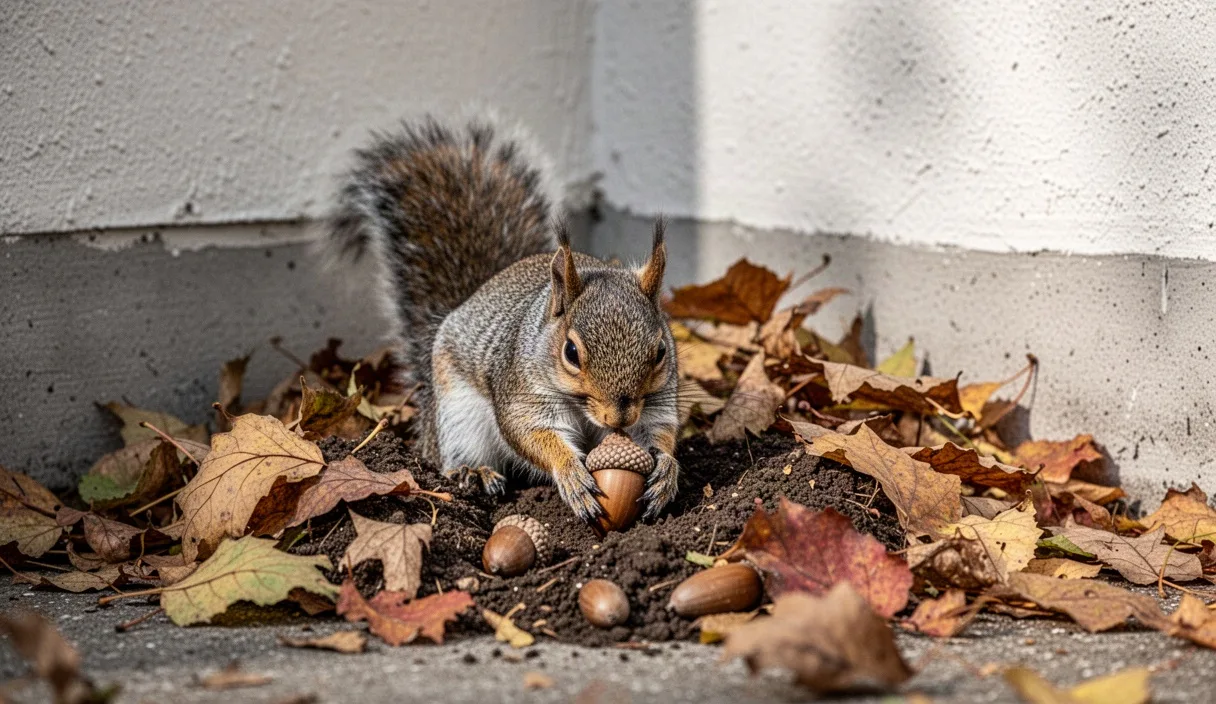
Autumn changes a squirrel's day. The pace quickens. The paths through a yard become worn and specific. None of this is random.
What looks like frantic movement is a set of survival tasks, done in sequence, driven by daylight and temperature. This guide breaks down what is actually happening, section by section, so the behavior reads clearly instead of chaotically.
Why autumn activity spikes
Daylight length drops fast in September and October. A squirrel's body reads that drop as a signal to prepare for scarcity. Food will not disappear overnight, but it will thin out within weeks.
Eastern gray squirrels, the most common backyard species in much of North America, increase their daily foraging time by several hours during this window. A squirrel that spent two hours a day gathering food in July may spend six or seven hours doing the same task in late October.
Cooler mornings also change timing. Squirrels shift activity toward midday, when temperatures are highest and energy cost of movement is lowest. This is why autumn sightings cluster between 10 a.m. and 3 p.m., unlike the dawn-and-dusk pattern common in summer.
The spike is not about excitement. It is about arithmetic: calories in, calories stored, calories needed to survive months with less available food.
What caching behavior looks like
Caching is the act of hiding food for later use. Squirrels use two methods, and both are visible if you know where to look.
- Scatter hoarding: single nuts or seeds buried in separate shallow holes, spread across a wide area.
- Larder hoarding: larger quantities stored in one place, such as a tree cavity or den.
Most gray squirrels rely on scatter hoarding. A single squirrel can create over 3,000 individual caches between September and December. Each hole is shallow, usually one to two inches deep, and covered quickly with soil, leaves, or grass.
Watch closely and the sequence repeats: dig, place, cover, pat down with the nose, move on. The whole cycle can take under fifteen seconds. This is not careless work. It is fast because it is practiced.
Territory disputes explained
Autumn is also when territory conflicts rise. Food is being claimed, buried, and defended, and other squirrels notice.
Chasing, tail-flicking, and loud chattering are the three most common signs of a dispute. These are not injuries in progress. They are warnings, meant to end the encounter before it becomes physical.
A mature squirrel may defend a core area of roughly a quarter acre, though this varies by habitat density and food availability. Overlapping ranges are normal in yards with multiple mature trees, which is why disputes cluster around oak, hickory, and walnut trees specifically.
Most conflicts last under thirty seconds. If a chase continues for several minutes and ends in contact, that is unusual and worth noting, but it is still rarely dangerous to nearby pets or people.
How squirrels track buried food
The common assumption is that squirrels forget most of what they bury. Research does not fully support that.
Studies on fox squirrels and gray squirrels show that scent plays a strong role in relocation, especially for caches buried by other squirrels. But spatial memory plays a larger role for a squirrel's own caches.
Squirrels use a method researchers call chunking: grouping cache locations by landmark, distance, and angle from a fixed point, such as a fence post or tree trunk. This is similar to how a person might remember where they parked by counting rows instead of memorizing the exact spot.
Recovery rates vary. Some studies estimate squirrels successfully relocate a meaningful share of their own caches, while other buried nuts are found later by different squirrels, birds, or simply sprout into new trees. That inefficiency is not failure. It is part of how oak and walnut trees spread every year.
Signs a squirrel is preparing for winter
Several visible changes signal that winter prep is underway, not just food gathering.
| Sign | What it means |
|---|---|
| Thicker, fuller tail | Insulation growth for colder months |
| Increased nest-building | Reinforcing a den before temperature drops |
| More frequent tree-to-ground trips | Actively gathering rather than resting |
| Shorter foraging radius | Staying closer to a chosen den or cache zone |
| Reduced vocalization | Conserving energy as temperatures fall |
Nest reinforcement is one of the clearest signs. A squirrel will add leaves, bark strips, and moss to an existing nest, called a den or nest depending on location, usually in late October. This nest, known as a "leaf nest," can look messy from the ground but is tightly woven when examined up close.
Weight gain is another marker, though it is harder to observe directly. A healthy squirrel entering winter typically carries noticeably more body fat than the same squirrel in June.
Common misreadings of the behavior
Several patterns get misunderstood, often leading to unnecessary concern.
- "It's sick because it's digging so much." Digging at this rate is normal seasonal behavior, not a sign of illness.
- "It's lost, it keeps circling the same tree." This is often cache-checking, not disorientation.
- "Two squirrels fighting means one is injured." Most chases end without contact or harm.
- "It buried food in my planter, so it will come back and destroy it." A single cache visit is common; repeated digging in the exact same spot is not.
- "Squirrels store food in attics for winter." Squirrels may nest in attics, but they rarely store large food supplies there. Nesting in a structure is a separate issue from foraging behavior.
If a squirrel appears in the same reachable, permanent shelter for multiple days rather than trees, or shows signs of injury such as limping, matted fur, or labored breathing, a local wildlife rehabilitator can assess the situation. This is not something to diagnose from a distance.
What to expect as winter nears
Behavior shifts again once temperatures drop consistently below freezing.
Activity slows, though squirrels do not hibernate. They remain active in short bursts, often limited to midday, and rely heavily on the caches built during autumn.
Nest use becomes more concentrated. A squirrel may spend several consecutive days in one den during a cold snap, only emerging briefly to feed. This is different from disappearance; it is energy conservation.
By late winter, cache visits decrease as stored food runs low, and squirrels begin supplementing with tree bark, buds, and any remaining nuts still findable under snow cover.
Common mistakes
People often intervene in ways that complicate rather than help.
- Feeding squirrels by hand, which increases boldness and dependency.
- Removing all visible nuts from a yard, assuming this discourages digging, when it usually just shifts caching elsewhere.
- Sealing attic entry points without confirming a squirrel has already left, which can trap an animal inside.
- Assuming aggressive-sounding chatter always signals danger to pets, when it is more often a territorial warning between squirrels.
Next steps
Watch a single squirrel over several days if possible, rather than several squirrels once.
Note where it digs, how long each cache takes, and whether it returns to the same tree. Patterns become clear within a week.
If a squirrel shows signs of injury, disorientation lasting more than a few minutes, or repeated entry into a home structure, contact a licensed wildlife rehabilitator or local animal control office rather than attempting to handle the animal directly.
Otherwise, autumn squirrel activity needs no correction. It is a short, busy season with a clear purpose, and it ends on its own once the ground freezes.